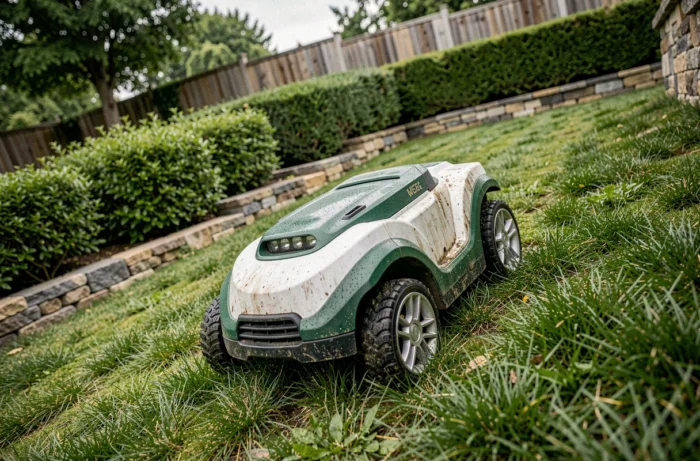
A slope with more than 40% incline, a lawn that descends towards a stream, a ramp access between two terrace levels: in these configurations, most robotic mowers struggle, skid, or simply refuse to climb. Choosing a robotic mower for steep slopes does not mean selecting a standard model with good wheels. The terrain imposes its own criteria, and ignoring them can be costly.
Manufacturer’s announced slope capacity: why it needs correction
On the technical sheet, a robot displays a maximum slope in percentage. This figure corresponds to a test under ideal conditions, on dry and short grass. In real terrain, with wet grass, loose soil, or a sudden transition between two levels, the effective capacity drops.
The most reliable method is to subtract 5 to 8 points from the manufacturer’s percentage to estimate the actually traversable slope. A model rated at 45% will therefore hold around 37 to 40% under normal conditions. If the steepest slope in your garden reaches 35%, aiming for a robot specified at a minimum of 45% leaves a reasonable safety margin.
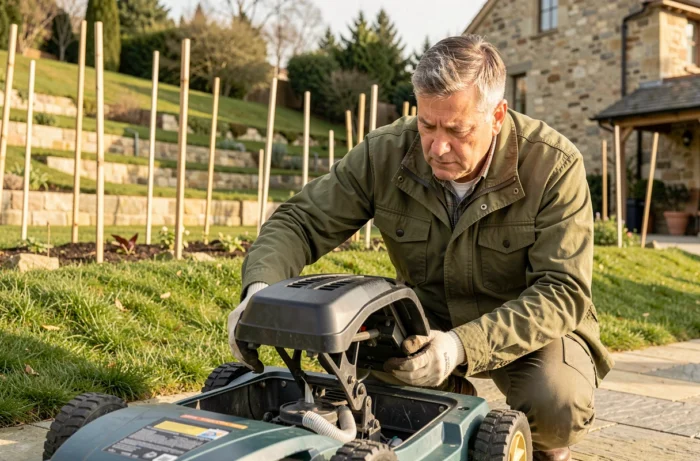
To measure the slope, place a board of at least one meter flat on the ground and use an inclinometer or a leveling app on your smartphone. The measurement should be taken at the steepest point of the terrain, not in the middle of the lawn. It is this maximum value that determines the choice of robot.
Recent AWD (all-wheel drive) models, such as the Dreame A4 AWD Pro or the Mammotion Luba 4 AWD ranges, announce capabilities between 80% and 90%. We enter a category of machines designed for very steep slopes, well beyond the 35 to 45% that most comparisons consider the upper limit.
For truly sloped terrain, choosing a robot mower suitable for steep slopes makes the difference between a device that works and one that skids halfway.
RTK navigation, LiDAR, or vision: the real factor on sloped terrain
One first thinks of the wheels and traction. In practice, the quality of the positioning system is as important as the drive on a slope. A robot that loses its position on a slope will turn in circles, pass over the same spot ten times, or drift into a restricted area.
Three technologies share the market in 2026:
- RTK-GNSS offers centimeter-level accuracy outdoors and allows the robot to follow regular parallel trajectories, including on slopes. It requires a reference station and performs less well under dense canopy.
- 3D LiDAR maps the terrain in real-time and detects variations in relief. It works under trees but generally costs more for equivalent technology.
- Stereo vision (cameras) is progressing rapidly and allows obstacle avoidance without peripheral wiring. Feedback varies on this point depending on lighting conditions and tall vegetation.
On sloped terrain with shaded areas or trees, a robot equipped only with RTK risks losing its grip under cover. Conversely, a LiDAR or vision model handles these transitions better but may react differently to a bare slope in full sunlight. Combining satellite navigation and onboard sensors remains the most reliable configuration for slopes.
Wired or wireless: specific constraints for slopes
The perimeter wire defines the mowing area by creating a magnetic signal. On flat terrain, its installation is straightforward. On sloped terrain, everything becomes complicated.
The wire must run along the edges, including in sloped areas. The robot slows down as it approaches the wire, and on a steep slope, this slowdown can cause lateral slipping. Some installers recommend retracting the wire by at least 30 centimeters from the actual edge in the steepest areas to prevent the robot from exceeding the limit by skidding.
Wireless models (RTK navigation or vision) eliminate this constraint. Boundaries are defined virtually from an app, and the robot adjusts its trajectory in real-time. For gardens with multiple levels or isolated slopes, the absence of a wire significantly simplifies installation and reduces maintenance interventions.
Excluded zones and narrow passages
A sloped garden often has areas where the robot should not go: walls, stairs, raised beds. With a wire, each obstacle requires an additional loop of wire. Without wire, an exclusion zone can be traced on the app in seconds. In uneven terrain, this flexibility is not a luxury.
Wheels, weight, and cutting height: the details that change everything on slopes
Traction does not depend solely on the number of driven wheels. The tread pattern, wheel diameter, and weight of the robot play a direct role in grip.
A robot that is too light will skid on wet grass. A robot that is too heavy will leave marks on the ground in sloped turns, especially on soft terrain after rain. AWD models distribute traction better, but their higher weight requires wider wheels to avoid digging ruts.
The cutting height also deserves special attention. On a slope, grass grows unevenly: faster at the bottom (moisture), slower at the top (exposure). Setting the cut too low on a south-facing slope can scalp the lawn in the driest spots. It is beneficial to raise the cutting height by one notch in sloped areas and to increase the mowing frequency rather than cutting short in a single pass.
Crossable obstacles
Next-generation robots claim to cross obstacles up to about 7 centimeters. On sloped terrain, a protruding root or an edge of a slab that would pose no problem on flat ground becomes a blocking point when the robot is under load. Checking the crossing capacity in an inclined context, not just on the product sheet, avoids unpleasant surprises.
The choice of a robotic mower for steep slopes relies on three concrete checks: the actual maximum slope of your terrain (measured, not estimated), the type of navigation suited to your vegetation cover, and the delimitation mode compatible with the topography. Machines capable of climbing beyond 70% are now available on the consumer market, opening up possibilities for gardens long considered impossible to automate.