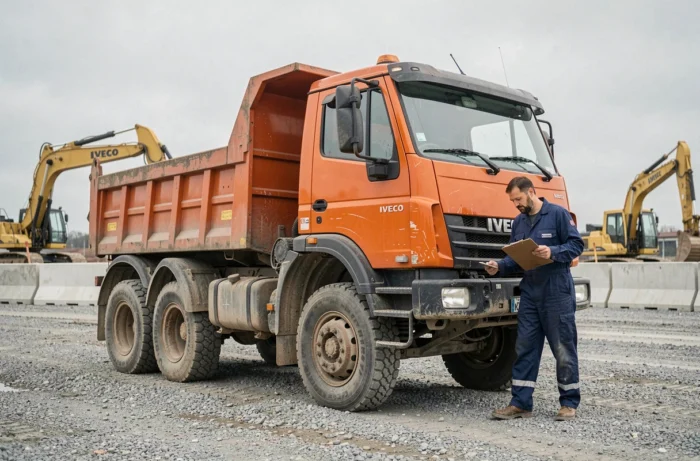
An Iveco Daily tipper truck displayed at an attractive price with reasonable mileage does not guarantee anything about the actual condition of the vehicle. The odometer tells only a fraction of the story: it is the type of mechanical stress, the frequency of tipping cycles, and the condition of the chassis under the body that determine the true value of a used tipper truck.
Engine clogging and emissions control on an Iveco Daily tipper: what mileage doesn’t tell you
A Daily used for short trips with frequent stops or episodes of overload presents an accelerated risk of clogging of the EGR and particulate filter. This phenomenon affects vehicles that sometimes show moderate mileage, misleading buyers who rely solely on the odometer.
We recommend systematically requesting the history of DPF regenerations and any instances of degraded mode operation. A Daily that has made numerous urban deliveries or worked in confined areas accumulates soot much faster than a vehicle regularly driving on open roads.
Recurring emissions defects on a used Iveco tipper often indicate prior use incompatible with the longevity of the powertrain. Mechanical inspection should therefore focus on the differential pressure sensors, EGR valve, and urea injector if the vehicle is equipped with an SCR system.
Before committing, it is useful to consult specialized resources for buying a used Iveco tipper truck with full knowledge, particularly regarding the inspection points specific to 3.5-ton models.

Inspection of the chassis and anchoring points of the Iveco tipper
The tipper often conceals the actual condition of the supporting structure. Signs of perforating corrosion at the suspension anchoring points or cross members can render a vehicle unfit for technical inspection, even if the visible bodywork appears sound.
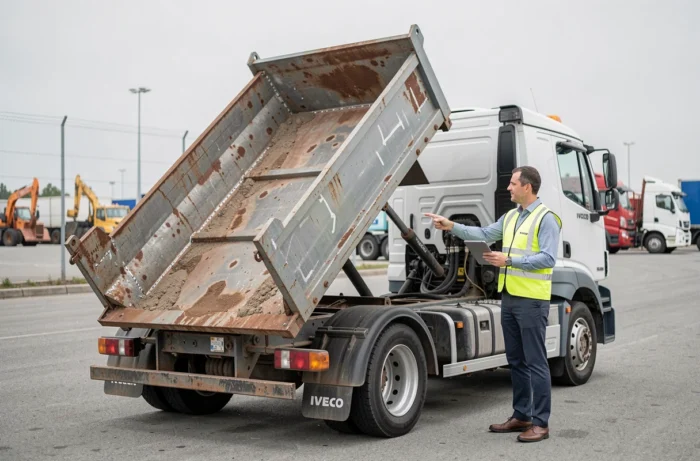
Inspecting the underside of the vehicle is the only reliable way to assess structural fatigue. On an Iveco Daily chassis-cab converted into a tipper, the reinforcement welds and body fixings undergo repeated stresses with each lifting cycle.
Points to check under the tipper
- Condition of the beams and cross members: look for any deformation, cracks, or non-compliant welding repairs according to Iveco specifications
- Fixings of the hydraulic cylinder and control circuit: oil leaks, play in the axes, wear of cylinder seals
- Corrosion of the rear suspension supports: a regularly overloaded Daily tipper shows premature wear of the springs or bushings
- Compliance between the maximum authorized weight (PTAC) stated on the registration certificate (sections F.1, F.2, G.1) and the actual configuration of the installed tipper
A weakened chassis cannot be repaired at low cost. If the beams show perforations, the vehicle loses all operational value.
ZFE restrictions and Euro standard: a technical buying criterion
The ZFE risk must be assessed on a municipality-by-municipality basis, not just via the Euro standard. Each low-emission zone applies its own time slots, exemptions, and access conditions. An Iveco Daily classified as Crit’Air 2 can circulate freely in certain urban areas while being excluded from others, depending on the current municipal decrees.
The French policy aims to end the sale of new heavy vehicles primarily using fossil fuels by 2040, with a goal of complete decarbonization of land transport by 2050. A Euro 5 diesel purchased today at a good price risks accelerated depreciation if your sites are located in dense urban areas.
We observe that many buyers neglect this verification and end up with a vehicle usable only in rural areas. Before signing anything, contact the relevant authorities to confirm the actual access of your future Iveco tipper to the areas where you operate.
Used Iveco tipper truck: documents and warranty before signing
Administrative rigor protects as much as mechanical inspection. An incomplete file is often a sign of a patchy maintenance history or a vehicle whose owner is trying to hide a past.
Documents to demand before traveling
- Original registration certificate with verification of weight sections (F.1, F.2, G.1) and the national type of the vehicle
- Report of the last valid technical inspection, with careful reading of the defects subject to re-inspection
- Maintenance invoices and service book, particularly for interventions on the hydraulic circuit of the tipper and the emissions control system
- Certificate of administrative situation (no lien) dated less than fifteen days ago
Regarding warranty, a vehicle sold by a professional benefits from a legal compliance warranty. However, between private individuals, no warranty applies unless explicitly stated in the contract. Negotiate at least a precisely drafted hidden defect clause, including the condition of the chassis, engine, and lifting mechanism of the tipper.
On the registration side, ensure that the model, body type, and PTAC correspond well to the use you plan. An Iveco Daily initially registered as a van and then converted into a tipper may present administrative inconsistencies that will block the transfer of the registration certificate.
Buying a used Iveco tipper truck remains a solid investment for professionals in construction, landscaping, or agriculture, provided one does not limit oneself to the exterior appearance or the displayed price. Checking the powertrain, the chassis under the body, and ZFE compatibility forms a triptych that every buyer should systematically follow before signing.