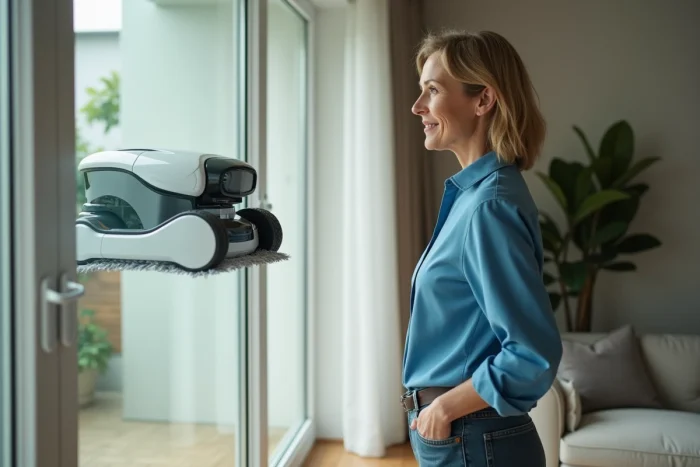
A window-cleaning robot that costs twice as much as another does not necessarily guarantee windows that are twice as clean. Behind almost identical technical specifications, the differences in performance and price can sometimes be incomprehensible. UFC Que Choisir has scrutinized the main devices on the market, dissecting their strengths and weaknesses. Their conclusions reveal marked discrepancies in safety, speed, and ease of use. And some surprises that challenge preconceived notions.
What the UFC Que Choisir test reveals about window-cleaning robots
To understand the true face of the market, the latest window-cleaning robot test by UFC Que Choisir analyzes the differences in technologies and uses. These machines promise to relieve their owners of a tedious chore: cleaning high windows, bays, mirrors, or even shower walls. Behind this dream of autonomy, many models highlight their technological advancements, intelligent navigation, precise edge detection, and anti-fall sensors. In practical terms, this limits breakage and reassures those who work on high glass surfaces. The combination of a safety cable and backup battery enhances this peace of mind, especially in apartments on higher floors.
In terms of usage, not all robots operate on the same level. The spraying system, for example, can be fully automated or require a manual action for each session. Microfiber pads, remote control operation, via remote or mobile app, and rechargeable bases enrich the accessory palette. The user experience also depends on the robot’s ability to seamlessly transition between mirror, window, and shower wall without faltering.
However, limitations persist. In the majority of tests, edges and corners resist automation: manual touch-ups are necessary to correct missed spots. Wired models do not face battery depletion, but their cable restricts freedom of movement. Conversely, the autonomy of a cordless robot requires anticipation: running out of battery mid-window is not an option.
Surprisingly, investing in the most sophisticated model does not guarantee escaping all flaws. Price and marketing promises are not enough to ensure perfection, far from it. Between gimmicky features and real differences, consumers face an abundance of options that do not always deliver on their daily commitments.
Which models truly stand out: strengths, limitations, and innovations
The examination conducted by UFC Que Choisir reveals a clear hierarchy among the tested robots. High-end models approach cleaning differently: precise navigation, automatic spraying, easy recharging via a dedicated base, and possible remote management through an app. On large surfaces or complex windows, this technology refines the action, paces the work, and reduces the time spent monitoring the robot.
Safety remains a cornerstone. Backup batteries and cables limit risks, ideal for large glass doors. In the mid-range, manufacturers focus on the balance between ease of use and cost control. Adequate navigation, practical accessories, and included remote controls: these robots fulfill their mission for the vast majority of common glass surfaces.
To illustrate the differences, here’s what stands out from the analysis:
- Strengths: marked automation, reliable safety devices, comfortable use, compatibility with most glass surfaces.
- Limitations: often imperfect angles and edges, the need for manual touch-ups to achieve a flawless result.
On the practical side, versatility is appealing: wired or hybrid robots as long as the outlet is nearby, battery-powered robots for maximum freedom, everyone finds what suits them. The reduction of physical effort is attractive, as is the time saved. But no robot completely eliminates the need for human verification on stubborn corners. Recent advancements make maintenance more intuitive, without completely erasing a degree of constraint.
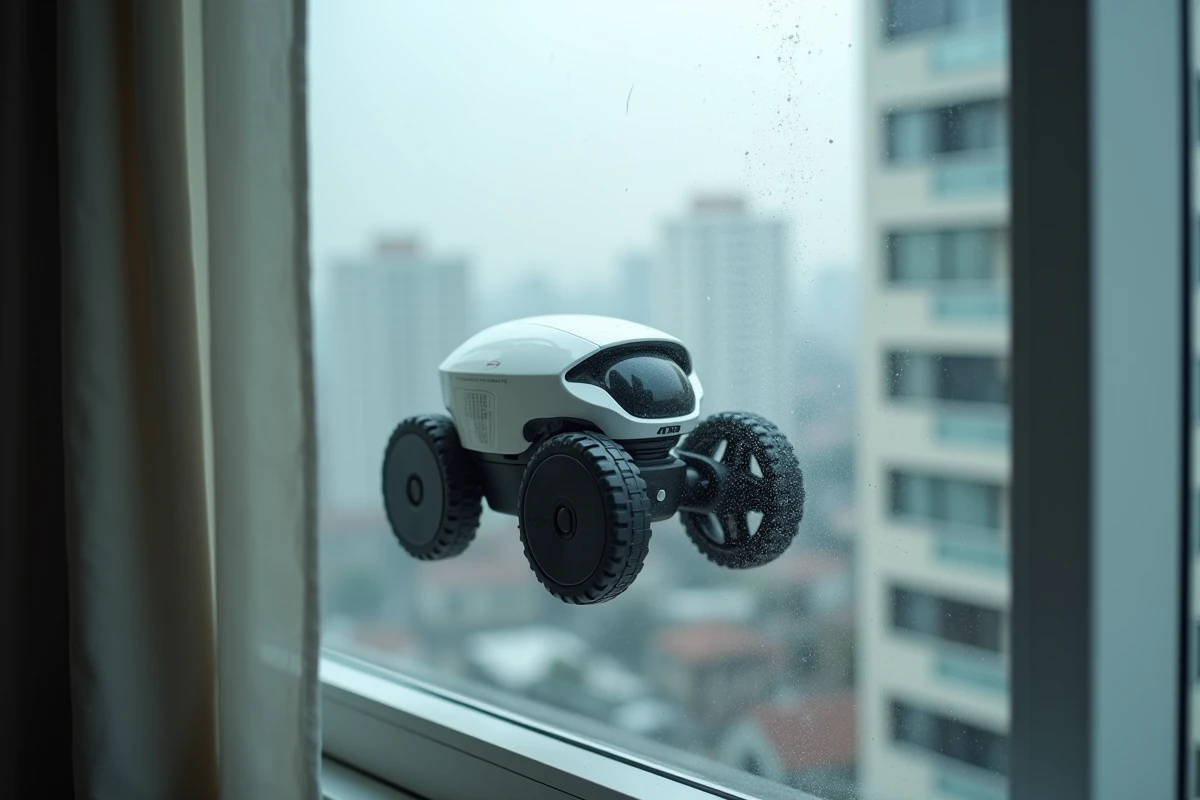
Value for money, user reviews: how to choose the robot suited to your needs?
The market is organized around reliable criteria: suction power, autonomy, safety, ease of use, and adaptability to different types of glazing. The test results remind us that the choice must be rooted in the reality of each household: surface to be treated, height, frequency of use. For large glass doors or hard-to-reach windows, models equipped with a safety cable and backup autonomy stand out.
To concretely guide the choice, it is useful to rely on the following characteristics:
- Intelligent navigation: edge detection, obstacle management, limited oversights.
- Nearly autonomous maintenance: effective microfiber pads and automatic detergent distribution.
- Ease of use: remote controls, user-friendly apps in an already connected home.
- Value for money: most mid-range robots offer a satisfactory compromise between cost and efficiency.
User feedback highlights a real time gain, less effort, and increased safety when working on difficult glass surfaces. Some regret the noise produced, akin to a vacuum cleaner, and the limited autonomy of battery-operated robots during long sessions. The overall result remains consistent, even if a manual pass is necessary to perfect the most challenging corners.
Before investing, it’s best to check the warranty duration, the availability of accessories, particularly replaceable microfiber pads, and the robot’s compatibility with the width of your glass surfaces. These details, often overlooked at first, make a difference during repeated use.
Faced with the living room windows and shower walls, the window-cleaning robot is gradually finding its place. However, innovation, as appealing as it is, does not completely replace real life: for finishing touches, the human hand still has the advantage. Automation is advancing, but the last corners are still waiting for their sponge treatment.