Students aiming for interior architecture are increasingly choosing to train in the South of France. This choice is not solely due to the pleasant living environment. The region concentrates educational, climatic, and professional conditions that directly shape the way of learning to design interior spaces.
Climatic Constraints of the South and Learning Space Design
Have you ever noticed how heat radically changes the way we use a room? In the South, a living room facing south without solar protection becomes unlivable in summer. This is exactly the type of problem that students learn to solve in the field.
The RE2020 imposes strict requirements on new constructions regarding the envelope, insulation, joinery, and solar protections. The South offers a direct application ground for these standards, because thermal constraints are more pronounced there than elsewhere in France. A student designing an interior layout in Toulon or Marseille must integrate the management of summer overheating from the project phase.
This daily confrontation with the Mediterranean climate develops a design reflex that theoretical courses alone do not convey. Choosing a flooring, positioning a partition, defining the type of glazing: each decision is measured against the test of real sunlight, not an abstract case study.
Interior Architecture Training in the South: A Structured Offer
The attractiveness of the South for students is based on a recognized and diverse training offer.
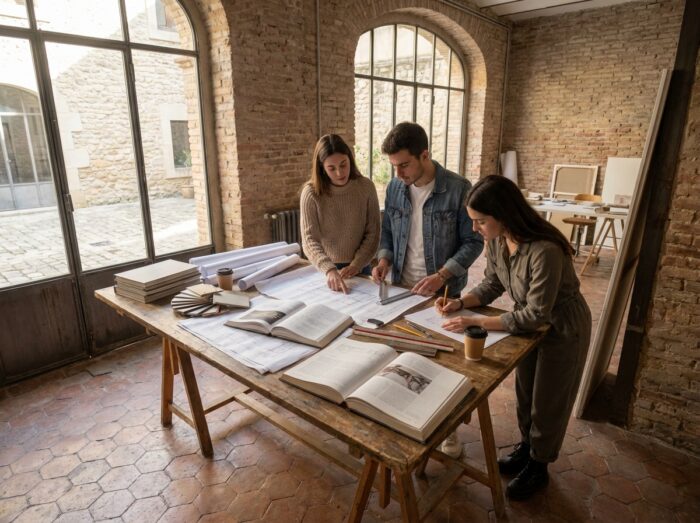
In Aix-en-Provence, the Skolae Campus prepares students for the profession of interior architect-space designer with a two-year curriculum accessible after a bac+3, leading to a level 7 certification registered with the RNCP. This level corresponds to a bac+5, placing the training on par with many engineering or master’s degrees.
Interior architecture training focuses on the design and transformation of interior spaces. Public architecture schools (like ENSAP Bordeaux) prepare students for the State Diploma of Architect in five years, with pathways towards urban planning, heritage, or project management.
The South attracts creative profiles oriented towards space design, not necessarily those aiming for overall project management of a building. Several cities in the South offer this specialization, and Montpellier, a favored city for future interior architects, exemplifies this dynamic with a local network of agencies and residential projects.
Built Heritage of the South of France as a Teaching Tool
Working on interior architecture in the South means dealing with an extremely varied built heritage. Students work on Haussmannian apartments in Marseille, stone Provençal farmhouses, 17th-century bastides, and Art Deco buildings in Nice.
Each typology imposes specific technical constraints: thick stone walls that refuse certain types of fixings, irregular ceiling heights, terracotta floors to preserve, and old joinery to integrate into a contemporary project. Learning to negotiate with the existing structure is a skill that the professional market actively seeks.
Rehabilitation projects are particularly numerous in the city centers of the South. Unlike new construction areas where the student starts from a blank slate, here the old buildings dictate part of the project. This constraint develops adaptability, a quality that recruiters value in young graduates.
- Farmhouses and bastides require working with local materials (limestone, lime plaster, terracotta) and respecting the thermal inertia of the old buildings.
- City center apartments, often narrow and deep, require mastering the circulation of natural light over large depths.
- Contemporary villas along the coast, numerous between Marseille and Nice, allow for experimenting with layouts open to the outside with issues of continuity between indoors and outdoors.

Professional Network and Integration into the Interior Architect Profession
The South of France concentrates an active market for interior renovation, driven by high-end tourism, second homes, and the rehabilitation of old centers. For a student, this means more direct access to internships, construction sites, and first contracts.
Interior architecture agencies in the South regularly recruit locally trained profiles. The proximity between schools and the professional fabric shortens the integration path. A student trained in Toulon or Aix-en-Provence already knows the artisans, material suppliers, and local regulatory constraints.
Events dedicated to design and architecture expose students to contemporary practices and allow them to build a network even before graduating.
Living Environment and Cost of Studies in the South
The cost of student living in cities like Toulon, Montpellier, or Aix-en-Provence remains lower than in Paris. A lower housing budget frees up resources to invest in project materials (models, software, prints), an often underestimated expense in space design training.
The Mediterranean setting also impacts the quality of creative work. Natural light, abundant for much of the year, facilitates workshop work and project photography. Students have an environment where the boundary between living space and learning space naturally blurs.
The South of France does not just attract interior architecture students with its climate. It offers them a comprehensive training ground, where regulatory constraints, built heritage, and the local professional market form a foundation that few French regions combine with such density.