
Arranging and decorating your home is not just about choosing a style from a catalog. It is primarily a matter of physical constraints: available natural light, room proportions, circulation between spaces. Starting from these concrete data avoids costly mistakes and unnecessary purchases.
Passive decor: improving comfort without heavy work
The rise in energy costs has brought to light a simple principle: certain decorative elements play a measurable thermal or luminous role. A blackout and thermal curtain placed in front of a poorly insulated window reduces heat loss much more effectively than a standard sheer curtain.
Window films, heavy rugs placed on tiled floors, or reflective paints applied to a south-facing wall combine aesthetic and insulation functions. This approach, sometimes called passive decoration, has been developing significantly since 2023.
Specifically, before repainting a living room or changing a sofa, it is better to evaluate three elements that directly influence the comfort felt in a room:
- The quality of curtains or blinds: a fabric lined with a thermal layer changes the perceived temperature in winter and summer while dressing the window.
- The flooring or its complements: a dense rug on a cold tile transforms the use of a living space without any construction work.
- The color of walls exposed to sunlight: light and matte shades reflect more light and limit heat accumulation.
These choices do not cost more than purely aesthetic decoration. They simply guide purchases towards products with dual functions.
Sustainable furniture and second-hand: renewing your decor differently
Since 2023, brands like Ikea and Maisons du Monde have structured resale, buy-back, and furniture repair services. This is no longer a niche market: second-hand is now part of the traditional furnishing circuits. Dedicated sections exist online and in stores.
Choosing a second-hand piece of furniture or restoring an antique dresser often results in a more unique decorative outcome than a standardized new purchase. Solid wood, full-grain leather, or ceramics age beautifully over time without losing their strength, making them ideal materials for furniture meant to last. Exploring the home universe of Ei Mag allows you to identify concrete avenues for aligning these sustainable choices with a coherent decor project.
The repairability score, already mandatory for certain electronic devices, is beginning to extend to visible equipment in the home: lighting, small kitchen appliances displayed on a countertop. This criterion is gradually guiding purchases towards modular products, for which spare parts remain available.
Light and proportions: two underestimated levers in interior design
Natural light determines the perception of a space much more than wall color. A north-facing room will always appear smaller than a south-facing room of the same size. Adapting the decor to this reality avoids artificial corrections (over-lighting, systematic white paint) that often produce a cold result.
Multiplying light sources at different heights transforms the atmosphere of a living room or bedroom. A reading lamp near an armchair, indirect lighting behind a low piece of furniture, and a dimmable ceiling light create distinct zones within the same room without partitioning.
Playing with furniture proportions
A sofa that is too bulky in a small living room poses more than just a circulation problem. It visually overwhelms the space and makes the rest of the decor feel secondary. The most reliable rule is to size the main piece of furniture according to the passage, not the floor area.
Leaving at least a comfortable passage between the sofa and the coffee table, and between the coffee table and the TV unit, is enough to create a sense of space. In a bedroom, the same logic applies to the bed: its size should allow for clearance on each side for the room to remain functional.
Textiles and color: building a coherent palette room by room
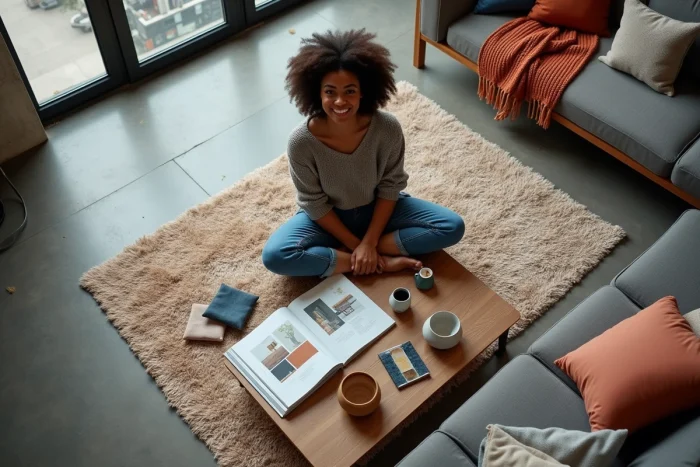
Approaching color on the scale of the entire house often leads to a result disconnected from the reality of each room. Each space has its own light, function, and rhythm of use. A kitchen can handle more saturated shades than an office or a bedroom.
The simplest method to avoid visual cacophony is based on one principle: choose two dominant shades per room and a single accent shade. Textiles (cushions, curtains, throws) serve as a link between these three colors. They can be easily changed and allow for evolving decor without repainting.
Natural materials and maintenance
Linen, washed cotton, and wool withstand frequent washing while maintaining their shape. In contrast, some synthetic fabrics lose their texture after a few cycles. This maintenance criterion weighs heavily in a living room or a child’s bedroom, where textiles are used daily.
A well-arranged interior relies less on the accumulation of objects than on the coherence between the physical constraints of each room and the choices of materials, light, and proportion. Frequent renewal is not necessary when the foundations are solid. It is better to invest time in observing your space than in searching for a seasonal trend.