
Noni (Morinda citrifolia) presents a problem that most online recipes overlook: its naturally high content of volatile fatty acids, particularly octanoic acid and hexanoic acid, which are responsible for the characteristic rancid smell of the ripe fruit. Mastering these compounds determines the difference between a drinkable juice and an olfactory repellent.
Octanoic Acid and Noni Fermentation: Controlling the Aromatic Profile
The spontaneous fermentation of noni amplifies the production of short-chain fatty acids. A patented process by Cirad (reference CR20130274 A, published in 2013) details an industrial approach that reduces these compounds below a defined threshold. The principle relies on grinding the fruit at the translucent white maturity stage, before endogenous enzymatic degradation massively releases these volatile molecules.
In domestic practice, we recommend picking or selecting the fruits at this precise stage. A noni that has turned yellow-brown and soft has already begun its internal fermentation. The juice obtained will be more loaded with foul-smelling compounds, and no addition of sweet fruits will fully compensate for this flaw.
The industrial enzymatic treatment combines pectinase activity and cellulase activity to liquefy the pulp without allowing time for degradation reactions. At home, a quick blending followed by immediate filtering partially reproduces this effect. Letting the crushed pulp rest at room temperature, even for an hour, significantly increases the intensity of the rancid taste.
Anyone wishing to delve deeper into the step-by-step method will find a homemade noni juice recipe suitable for domestic kitchen conditions, with guidance on fruit selection and filtering.
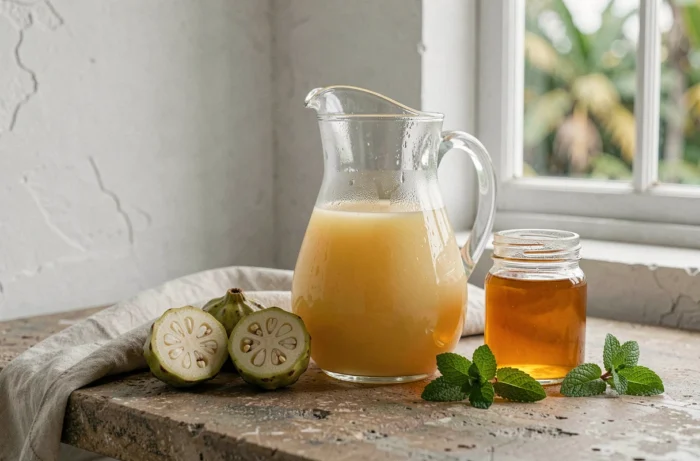
Fresh Noni Juice or Fermented Juice: Two Distinct Products
The confusion between fresh juice and fermented juice remains common. These are two preparations with different nutritional and organoleptic profiles.
Fresh juice is prepared in less than an hour, by blending and filtering a fruit at an early maturity stage. It retains more thermosensitive compounds and has moderate acidity. Its taste, although pronounced, remains more neutral than that of a fermented juice.
Traditional fermented juice, as practiced in Polynesia, requires about two months of sun maceration in a closed container. Ripe, even overripe, fruits are stacked whole, and the exuded liquid is collected after this long fermentation. The result is a concentrate with very pronounced aromas, difficult to consume pure.
Selection Criteria Based on Use
- For daily consumption diluted in another juice (apple, grape), fresh juice offers a more neutral base and can be stored for a few days in the refrigerator.
- For use in small concentrated amounts (a few tablespoons per day), traditional fermented juice is suitable, provided one accepts its taste profile and stores it in an opaque glass container.
- To mask bitterness without drowning out the product, we observe that mixing with grape juice works better than with orange juice, whose citric acidity accentuates unpleasant notes instead of softening them.
Health Safety of Homemade Noni Juice: Potassium and Novel Food
Noni is listed among the novel foods of the European Union, governed by the implementing regulation (EU) 2017/2470. This authorization concerns defined preparations with a specific manufacturing process. It does not automatically cover all homemade recipes or artisanal products containing noni.
In Brazil, Anvisa has adopted a more restrictive position via Technical Report No. 25: products containing Morinda citrifolia cannot be marketed as food without prior demonstration of safety. These regulatory disparities show that the food status of noni is not universal.
Potassium Content and Contraindications
The naturally high potassium content of noni requires particular caution. Individuals with kidney failure, those with a potassium disorder, or those taking potassium-sparing diuretics should avoid regular consumption without medical advice.
For homemade preparation, diluting in an equivalent or greater volume of water or neutral juice reduces the potassium concentration per serving. We recommend not exceeding a small glass per day in the absence of medical supervision and to suspend consumption at the first sign of digestive upset.

Preparation of Fresh Noni Juice: Simplified Protocol
Here is the protocol we use to obtain homemade noni juice with an acceptable aromatic profile.
- Select fruits at the translucent white stage, firm to the touch, without brown spots. Wash them thoroughly with clear water.
- Cut each fruit into quarters, remove visible seeds, and then blend immediately with a volume of cold water equivalent to half the volume of pulp.
- Filter the mixture through a fine sieve or cheesecloth, pressing the pulp. Do not let the juice rest at room temperature before filtering.
- Add white grape juice or apple juice (about one-third of the final volume) to soften the bitterness without completely masking the taste of noni.
- Store in the refrigerator in a closed glass bottle and consume within three days.
The speed of execution remains the determining factor. The shorter the time between blending and filtering, the less the juice develops rancid notes. A complete protocol, from cutting to bottling, should not exceed twenty minutes.
Common Mistakes to Avoid
Using overly ripe fruits remains the most common mistake. A completely translucent and soft noni has surpassed the suitable stage for fresh juice. It is only suitable for long fermentation.
The other pitfall concerns the container: plastic absorbs the odorous compounds of noni and becomes unusable for other purposes. Glass is the only suitable material, both for blending and for storage.
European regulations govern commercial preparations, but a homemade preparation intended for personal consumption is not subject to the same requirements. The responsibility for sanitary quality rests entirely with the preparer, making strict adherence to the cold chain and utensil hygiene all the more relevant.