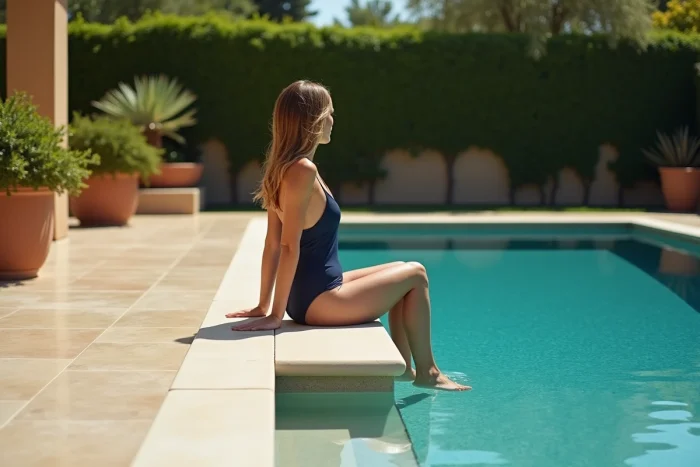
Choosing the dimensions of a pool bench involves balancing three variables: the desired water depth, the seat width, and the space that the bench takes away from the swimming area. These three parameters do not compensate for each other in the same way depending on the intended use, the users’ morphology, or the type of construction (shell, concrete, reinforced liner).
Water depth on the bench: what each centimeter changes
The water depth above the seat determines the comfort level more than any other measurement. A bench covered with little water exposes the torso and shoulders to the open air, which quickly cools the upper body as soon as the wind picks up.
Conversely, a water height that is too generous reduces the appeal of the bench for young children or for those who wish to sit without having water above their chest. The slider therefore adjusts differently depending on the usage profile.
| Water depth on the seat | Feeling and main use | Limit to know |
|---|---|---|
| About 20 cm | Soaking feet and calves, supervising children | Rapid thermal discomfort in windy weather |
| About 35-40 cm | Seated position submerged up to the hips, prolonged relaxation | Too deep for very young children without close supervision |
| About 50-60 cm | Torso immersion, wellness effect if jets are integrated | Reduces the swimming area if the pool is compact |
In recent years, premium installer networks have reported a trend to slightly increase the water height above the benches in projects equipped with Inverter heat pumps and automatic covers. With the water temperature being maintained more stably, users are willing to be more submerged and prioritize thermal comfort on the bench.
To delve deeper into the topic of ideal pool bench dimensions, the seat width deserves as much attention as the depth.
Seat width and ergonomics: the dimensions that really change comfort
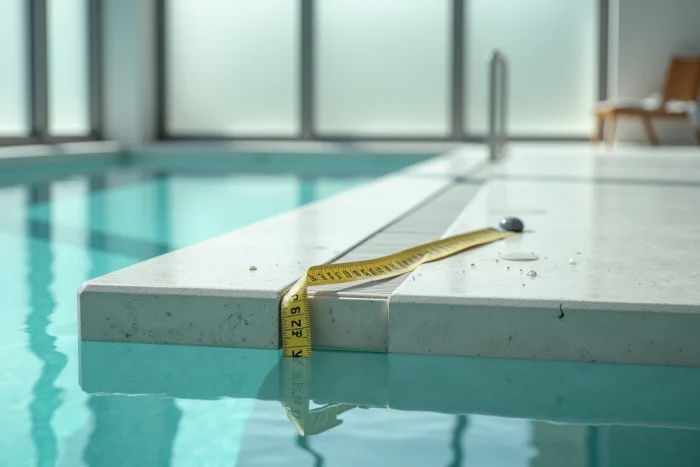
The width of the bench (distance between the edge of the pool and the step nose at the bottom) conditions posture. A seat that is too narrow forces one to keep their legs stretched forward to avoid slipping, which tires the lower back in just a few minutes.
A width of at least 50 cm allows for sitting without lumbar tension. Below this, the bench functions more like a step than a relaxation space. Shell pool models generally offer integrated benches whose width varies by range, with some reaching more generous seating along the entire length of the pool.
Full-width bench or corner bench
A bench that runs the entire width of the pool offers a continuous resting space. Several home insurers, including Groupama and MAIF, actually present this configuration as a positive safety element: a continuous bench constitutes an accessible resting area for children or swimmers in difficulty, just like a cover compliant with the NF P90-306 standard.
On the other hand, a corner bench or one limited to one side preserves more of the swimming surface. The choice depends on the total length of the pool: in a pool less than eight meters, a full-width bench can significantly reduce the usable swimming area.
Pool bench and accessibility for people with reduced mobility: an underestimated angle
Since 2023, several shell pool manufacturers have offered benches whose height is specifically designed for people with reduced mobility. The principle: a widened edge facilitates transfer from a wheelchair, and lower steps reduce the effort needed to enter the water.
These adaptations are still very rarely mentioned in mainstream content about bench dimensions. However, they concern an increasing number of projects, especially for residences where multiple generations coexist.
- The upper edge of the bench should be level with the coping to allow for lateral sliding from a seat.
- The depth of the first step should remain low (less than 20 cm of water) to provide an intermediate safety landing.
- The non-slip surface of the seat becomes a determining choice criterion once the user cannot easily catch themselves.

Impact of bench dimensions on pool volume and filtration
Each square meter of submerged bench reduces the total water volume of the pool. This reduction has two direct consequences: the complete recirculation time decreases (the pump processes a smaller volume), but the shallow area promotes localized warming conducive to algae growth if the hydraulic circulation is poorly sized.
The return jets positioned under the bench or on its step nose help maintain sufficient mixing. On models equipped with massage jets or hydrotherapy, this mixing is ensured by default. On a bench without wellness equipment, it is necessary to check that the hydraulic layout includes at least one return point in this area.
- A return directed towards the bottom from the bench nose prevents the stagnation of warm water on the surface.
- The skimmer closest to the bench should draw surface water across the entire width of the seat.
- In the case of a long bench (over two meters), a second return point is recommended by most installers.
Thus, the dimensions of the bench are not just a matter of comfort: they alter the hydraulic balance of the pool. Sizing the bench without adapting the filtration circuit amounts to creating a dead zone where water stagnates and treatment loses effectiveness. Before finalizing the dimensions, discussing the positioning of the jets with the installer remains the most useful precaution.