
You can request a quote online in just a few clicks, but in doing so you also share your address, photos of the worksite and sometimes an estimated budget with companies you know nothing about. Before filling out any form, a few practical checks can help you identify reliable tradespeople and rule out those who aren’t right for your project.
Who receives your quote request on an online platform?
On most matching platforms, homeowners fill out a single form. The request is then sent to several partner companies, sometimes three or four at once. The problem is that the form doesn’t always specify which companies will receive your contact details.
Before submitting anything, check whether the platform displays the names and SIRET numbers of the tradespeople it recommends. If this information only appears after you submit the form, you’ve already shared your data without being able to check who it’s going to.
Reading reviews of Welovetravaux.fr tradespeople can help you understand how some platforms select their professionals and what checks they carry out beforehand.
A useful habit: check the platform’s terms and conditions to see whether they mention a consumer mediation service. Professionals working with consumers must provide access to a mediator and share their contact details, in accordance with Articles L. 612-1 and L. 616-1 of the French Consumer Code. If this information is missing from the website or pre-contractual documents, ask about it before going any further.

Checking a tradesperson’s SIRET number: what the number alone won’t tell you
Every guide recommends checking the SIRET number. Enter it on the French Business Directory (annuaire-entreprises.data.gouv.fr) and you’ll find the company’s name, address and activity code. But a valid SIRET number doesn’t guarantee that the tradesperson is right for your project.
One step people often overlook is comparing the trade name and address provided by the tradesperson with the details registered in the Sirene database. A difference between the name on the quote and the official name may be perfectly legitimate (a trade name can differ from the registered company name), but it’s worth clarifying before sharing information about your project.
What to cross-check in the French Business Directory
- Establishment status: check that it is active and has not been struck off or placed in insolvency proceedings.
- APE code (main business activity): a code in the 43.xx range corresponds to specialist construction work, while a code in the 41.xx range relates to building construction. If the code points to consulting or retail, it’s worth asking why.
- Establishment address: a PO box or registered address with no business premises may indicate an intermediary rather than a tradesperson with the necessary equipment.
Decennial liability insurance and RGE certification: check exactly what they cover
Asking for proof of decennial liability insurance is a well-known precaution. Less well known is that a genuine certificate may not cover the work you’re planning. Article A. 243-2 of the French Insurance Code specifies that decennial liability insurance only covers activities declared by the company to its insurer.
In practice, a tradesperson insured for plumbing won’t be covered if they carry out external wall insulation. Check three things on the certificate: that the company name matches the one that will carry out the work, that the validity dates cover the planned start date, and that the declared activities include the type of work you’re requesting.
If in doubt, contact the insurer directly using the details on the certificate, and cross-check them against the insurer’s own website rather than relying solely on the document you were given.
RGE certification: the logo isn’t enough
For energy-efficiency renovation work eligible for financial assistance (MaPrimeRénov’, CEE), the tradesperson must hold an active RGE certification that covers the type of work in question. An RGE-certified installer of solar panels isn’t automatically certified to install a heat pump.
Suspended certifications no longer appear in official directories such as the Qualit’EnR directory. Search for the company by name or location; its listing shows active certifications and their validity dates. If the tradesperson claims to be RGE-certified but doesn’t appear in the directory for the type of work you need, it’s best to hold off on requesting a quote.
Comparing tradespeople’s quotes: match the scope before comparing prices
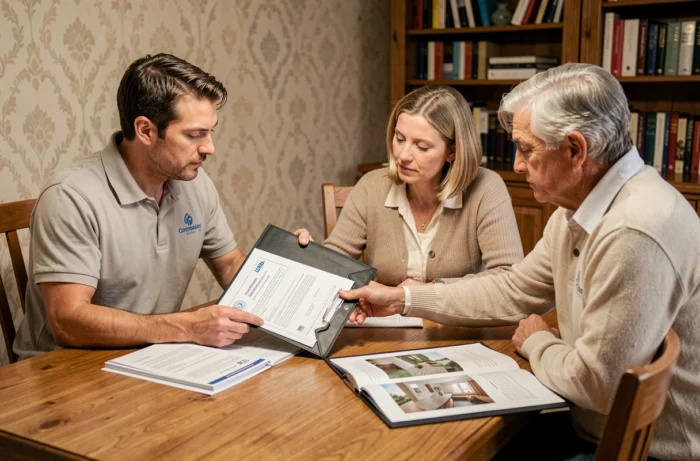
People often compare the prices at the bottom of the page. But two quotes with the same total can cover very different services. Before looking at the total, check that each quote lists the same items: whether materials are supplied or only installed, whether waste removal is included, and whether surface preparation is specified.
One point that’s rarely discussed: make sure the company that responded to your form is the one that will carry out the work. On some platforms, requests are sent to a broker or lead generator, who then passes them on. Asking explicitly whether the company signing the quote will do the work can help you avoid surprises when the project gets underway.
What makes a quote clear and easy to compare
- Precise descriptions of materials (brand, model and technical specifications) rather than a generic phrase such as “quality materials”.
- A breakdown of the unit price for each item, which makes it easier to spot an unusually inflated cost even if the total seems reasonable.
- Payment terms: a deposit that represents an unreasonably large share of the total and is required before any work begins is a warning sign.
- The quote’s validity period and the estimated work schedule, which commit the tradesperson to a timeframe.
A tradesperson’s reliability can’t be judged by a certification or online rating alone. Check it by cross-referencing official sources, looking beyond the surface of documents, and asking specific questions before sharing any information about your project. A reputable tradesperson will be happy to answer.