Some figures are anything but abstract: reducing IT processing times by 40%, without changing team sizes, is not a pipe dream but a reality for several airlines. Air France, long faithful to its own solutions, has seen specialized publishers take hold. Programmi Web, in particular, is changing the game by automating the synchronization of schedules, managing spare parts inventory, and crew allocation.
The adoption of these tools requires neither upheaval of infrastructure nor massive replacement of legacy software. It is the flexibility of modular interfaces that allows for a frictionless adaptation to the complexity of internal processes.
What are the major management challenges at Air France today?
Managing Air France means juggling regulatory, technological, and organizational constraints of an uncommon intensity. Since 1933, the airline has transported over 100,000 travelers each day, orchestrated more than 1,000 daily flights, and maintained a sprawling global logistics operation. This pace has pushed the company to invest early in organizational engineering: the creation of an operations research department as early as 1958, followed by the deployment of revenue management in the 1990s.
The digital transformation marks a new turning point. Migration to the cloud, Hadoop platform since 2012, use of KAFKA for real-time analysis: Air France has modernized its infrastructure to stay competitive. On the regulatory front, compliance with GDPR and AI Act standards is not optional. The AI Committee, under the leadership of Eric Poutrin, oversees ethical and regulatory governance, while Jean-Marc Janaillac directs the group’s overall strategy.
On this solid foundation, Air France is accelerating its efforts in generative AI. Since 2023, over 80 projects have been launched to automate processes, optimize schedules, enhance predictive maintenance, and refine service personalization. This momentum is made possible by a proven data architecture during crises, notably that of COVID-19. Programmi Web’s tools for Air France fit into this logic, offering integrated, modular management capable of evolving at the pace of a constantly changing sector.
Programmi Web: innovative solutions to transform internal organization
At Air France, innovation is not limited to technology: it permeates the entire organization. Programmi Web provides a series of solutions aimed at streamlining processes, enhancing team agility, and stimulating collective intelligence. The goal: simplify, accelerate, optimize.
Here are the main solutions deployed:
- Prognos, a predictive maintenance platform, anticipates failures and reduces downtime. Already adopted by over 80 airlines, it significantly boosts operational reliability.
- MY TRIP ASSISTANT and Chatbot Louis automate customer support and streamline internal request management through a conversational interface. TALIA, the internal ChatGPT, energizes knowledge transfer and business assistance.
- FOX analyzes customer feedback, while CHARLIE supports real-time maintenance, boosting the responsiveness of technical teams.
Innovation is also expressed through intrapreneurship programs like Boost the Future, in partnership with Yumana, which encourages employees to propose and realize new ideas. The numbers speak for themselves:
- 6,000 active users each season
- 600 ideas submitted each year
- 20 finalist projects
- 8 concepts selected
Under the leadership of Marine Gall and within the framework of the Campus Air France, led by Anne Grjebine, digital training takes center stage, supported by Unow. These initiatives foster a management approach resolutely focused on digital, driven by team engagement and a continuous innovation strategy.
Tangible results: how digital tools reinvent operational efficiency
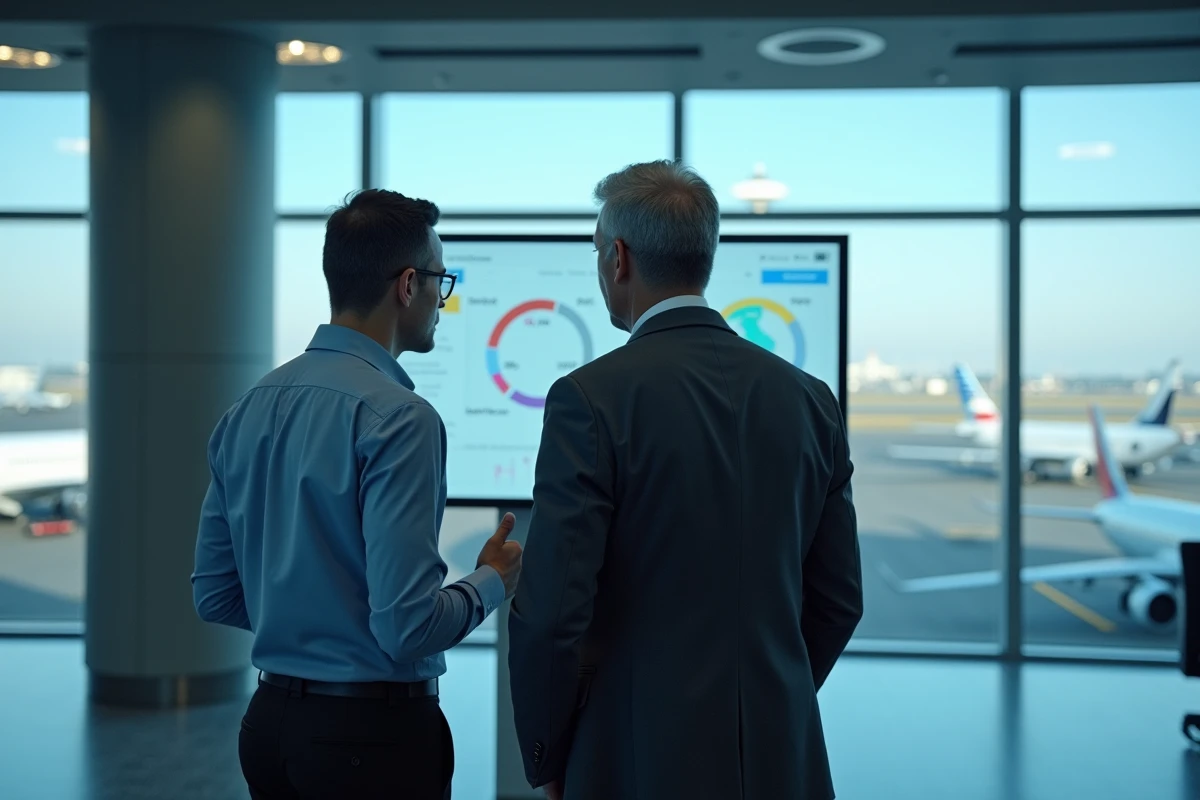
The digital transformation of Air France is reflected in daily operations: 2,300 flights each day, 546 aircraft, 312 destinations in 119 countries. This precision mechanism now relies on digital tools that change the game, from the cockpit to customer relations.
Thus, the Electronic Flight Bag, developed with Thales, replaces pilots’ paper files with a simple, interactive, and contributive interface. Decisions become sharper, operations gain in speed and reliability. Maintenance also evolves with the arrival of new onboard sensors and business applications: automatically tracked technical incidents, predictive planning, digitized monitoring. The result: less time wasted, fewer errors.
On the customer side, personalization progresses through the intelligent use of data. The Apple Watch app, the Flying Blue program, email automation: all leverage to create a tailored experience. Marketing teams adjust their offers in real-time by analyzing feedback while ensuring the security of exchanges and compliance with GDPR and AI Act regulations.
Equipped with robust digital tools, Air France is part of a renewed efficiency dynamic: streamlined flows, anticipation, personalized services. The trajectory is clear: each innovation strengthens reliability for both customers and employees. The digital era shapes a new standard, where performance leaves no room for improvisation.